 Skip to main content

Decoding Amy Webb’s Convergences: Part 1 of 10 — Compute Shock in Supply Chain & Logistics
Welcome to Part 1 of our 10-part deep dive into tech futurist Amy Webb’s annual SXSW trends presentation, specifically analyzing how her ten meta-convergences are reshaping global supply chains and logistics networks. Over the next ten installments, we will examine how exponential, overlapping technological trends are moving from theoretical tech-deck predictions into operational reality.
Today, we launch the series with Convergence 1: Compute Shock, a trend marked as Arrived for the logistics sector.
What is Compute Shock?
Compute Shock describes the sudden structural wall that organizations hit when the exponential demands of modern artificial intelligence—specifically deep learning, large language models (LLMs), and hyper-complex predictive simulations—outpace the physical reality of hardware, data centers, energy grids, and silicon supply chains.
For the past decade, enterprise technology operated under the illusion of infinite, cheap cloud elasticity. Need to run a larger algorithmic batch? Spin up another instance. Want to process real-time telemetry across 50,000 trucks? Just expand your cloud budget. Compute Shock is the awakening from that dream. It is the point where compute power shifts from being an invisible, line-item commodity into a finite, highly contested strategic constraint defined by microchip availability, local energy limits, latency bottlenecks, and skyrocketing operational costs.
The Supply Chain Reality: Why Compute Shock Has Arrived
In Amy Webb’s convergence matrix, Supply Chain & Logistics is marked as Arrived for Compute Shock—and for good reason. Global supply chain operations are among the most compute-intensive processes on the planet.
Consider what modern supply chain software is tasked with solving every second:
- Dynamic Combinatorial Optimization: Calculating the optimal routing for thousands of intermodal shipments, accounting for traffic, maritime weather patterns, port congestion, driver shift limits, and fuel consumption.
- Continuous Predictive Demand Sensing: Ingesting point-of-sale data, local weather forecasts, social media trends, and macroeconomic indicators to recalculate inventory stocking levels down to the individual SKU across hundreds of fulfillment nodes.
- Real-time Telemetry Processing: Ingesting constant streams of IoT data (temperature, location, vibration, door status) from millions of shipping containers simultaneously.
When enterprise logistics platforms integrate generative AI and heavy deep learning models to do this work, the compute footprint explodes. Running a deterministic Traveling Salesperson Problem algorithm is computationally heavy; running continuous, real-time agentic re-routing simulations across an entire global fleet requires astronomical computing power.
Logistics executives are now confronting the reality of Compute Shock in three distinct areas:
1. The Cloud Overhead Wall
Companies that aggressively integrated generative AI into their supply chain towers are discovering that query costs do not scale linearly—they scale exponentially. Processing unstructured logistics data (such as thousands of PDF bills of lading, customs declarations, and emails) through large vision-language models daily is driving cloud compute bills to unprecedented levels. The financial strain is forcing supply chain leaders to re-evaluate where raw AI compute actually delivers ROI versus where traditional, lighter algorithms suffice.
2. Edge Computing Hardware Bottlenecks
Centralized cloud processing creates latency that time-sensitive logistics cannot tolerate. An autonomous yard truck or an automated warehouse picker cannot wait 800 milliseconds for a cloud data center to compute its next movement path. To solve this, compute is moving to the “edge”—directly onto vehicle gateways, smart warehouse cameras, and container tracking hardware. However, edge compute hardware relies on high-performance microchips. As global chip shortages and hardware competition intensify, securing edge-AI processing hardware for logistics fleets has become a major supply-chain bottleneck.
3. Energy Constraints at Logistics Hubs
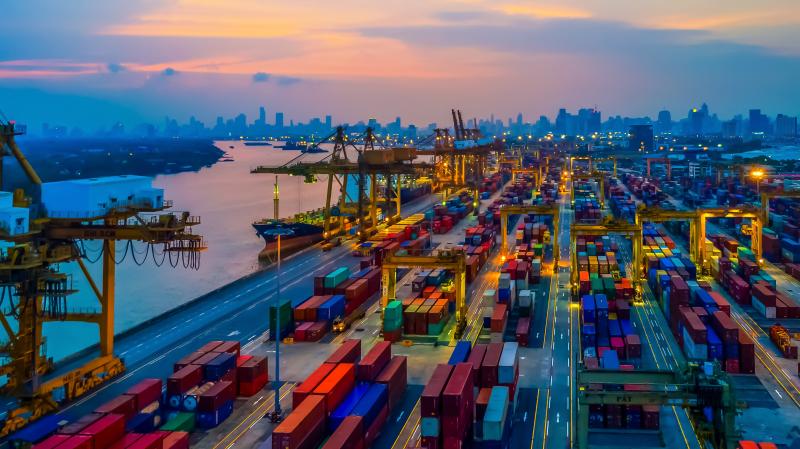
Mega-fulfillment centers, automated sorting facilities, and intermodal ports are transforming into massive computing centers. When thousands of automated guided vehicles (AGVs), automated storage and retrieval systems (ASRS), computer vision arrays, and local server racks operate under one roof, power draw spikes. In many regions, local power grids struggle to supply the wattage needed to support both heavy warehouse automation and localized AI compute, making energy availability a primary site-selection variable.
Strategic Playbook: Navigating Compute Shock in Logistics
Supply chain leaders cannot simply wait for hardware to get faster or cloud processing to get cheaper. Adapting to Compute Shock requires a fundamental shift in technical strategy:
- Shift to “Small-Model Architecture” and SLMs: Instead of relying on massive, energy-hungry foundational models for routine supply chain tasks, organizations must deploy specialized Small Language Models (SLMs) fine-tuned for logistics tasks (e.g., customs parsing or freight classification). Small models run at a fraction of the compute cost with lower latency.
- Prioritize Edge-Cloud Hybrid Architectures: Process immediate tactical decisions (e.g., forklift obstacle avoidance, gate camera scanning) locally at the edge using lightweight inference engines. Reserve heavy cloud compute strictly for broad, macro-level network optimization tasks executed on periodic schedules rather than continuous loops.
- Audit Compute ROI Across Logistics Applications: Not every logistics issue requires deep learning. High-performing organizations are auditing their tech stack to decouple traditional linear programming and rule-based automation from resource-intensive deep learning models.
Looking Ahead
Compute Shock is not a temporary bump in the road; it is the new baseline for global logistics. The supply chains that win over the next decade won’t necessarily be the ones with access to the most data. Still, those that run the most compute-efficient operations—maximizing every watt of energy and every cycle of silicon.
Join us tomorrow for Part 2: Polycompute, where we explore how logistics networks are adapting to Compute Shock by distributing processing power across multi-paradigm computing architectures, from quantum nodes to spatial environments.


